Why Cats Scratch Furniture—and How to Give Them Better Options

Your cat stretches against the sofa, digs in their claws, and leaves another set of marks. Meanwhile, the scratching post you bought stands untouched nearby. Why does the furniture seem so much more appealing?
Scratching meets important physical and behavioural needs. Protecting your home starts with understanding those needs, then offering scratching surfaces your cat finds comfortable, convenient, and rewarding.
1. Understand Why Cats Need to Scratch
Scratching helps cats maintain their claws by loosening the outer claw sheaths. It also gives them an opportunity to stretch and leaves visual marks and scent signals.
These functions make scratching a normal part of feline life. Even a relaxed cat with plenty of toys will still need suitable surfaces.
The practical goal is to guide scratching towards appropriate places. Trying to eliminate it entirely leaves an essential need unmet.
2. Notice What Makes the Furniture Attractive
Observe how and where your cat scratches before choosing an alternative.
A sofa arm offers a firm vertical surface. A rug allows horizontal scratching. The furniture may also sit beside a favourite sleeping spot or along a frequently used route.
Notice the texture, angle, height, and location your cat prefers. These details are useful clues. A small horizontal pad hidden in another room may not appeal to a cat who enjoys stretching upright against the sofa.
3. Choose a Stable, Appropriately Sized Scratcher
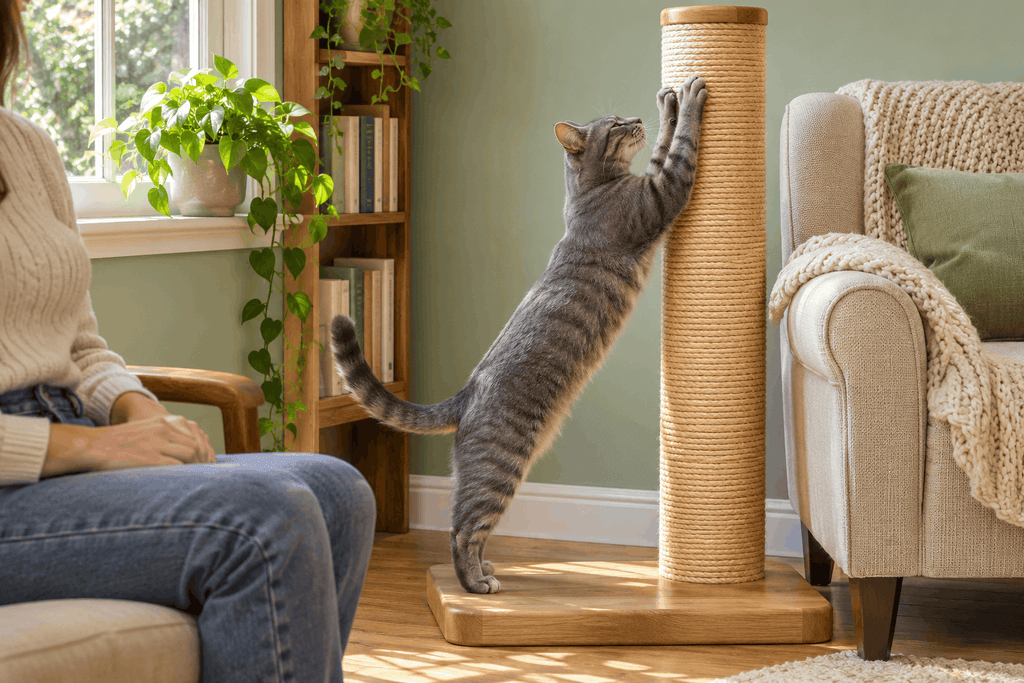
A vertical post should be tall enough for your cat to stretch fully and sturdy enough to stay still during use.
A wobbling base can make a post unpleasant or frightening. Check its stability on the actual floor where you plan to place it.
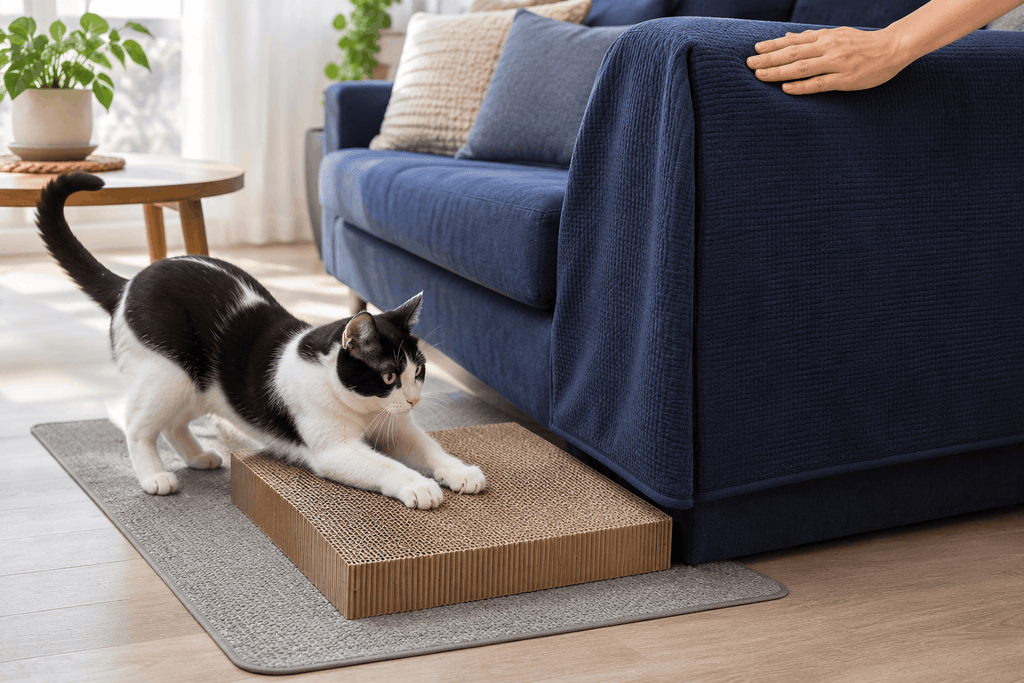
For horizontal scratchers, choose a sufficiently large pad that does not slide away. Some cats also enjoy angled boards.
Older cats or those with reduced mobility may find an accessible horizontal or gently inclined surface more comfortable. Match the arrangement to how your cat moves.
4. Offer a Choice of Textures
Cats have individual preferences. Sisal, corrugated cardboard, and other purpose-made scratching materials offer different sensations.
Start with a small selection rather than buying several identical posts. Watch which surface your cat chooses and whether they return to it.
Inspect scratchers regularly. Replace damaged items when they become unstable or develop hazardous loose parts. A worn surface does not necessarily need immediate replacement if it remains safe and your cat still enjoys it.
Texture and orientation work together: the right material may still be ignored if positioned at the wrong angle.
5. Place Scratchers Where They Are Needed
Put a suitable scratcher directly beside the furniture your cat already uses. This offers a convenient alternative at the moment the urge arises.
Another useful location is near a favourite resting place, since cats often stretch and scratch after waking.
Avoid hiding every post in an unused corner. In a multi-cat household, provide several options in different locations so one animal cannot block access to all of them.
If you eventually move a successful scratcher, do so gradually and watch whether your cat continues using it.
6. Reward the Scratching You Want to See
When your cat uses an appropriate surface, respond promptly with something they enjoy: a small treat, gentle praise, or a brief play session.
Keep the reward comfortable and unobtrusive. A nervous cat may dislike enthusiastic attention while scratching.
You can encourage investigation with a toy near the scratcher, but allow your cat to choose whether to engage. Put interactive toys away afterwards.
Do not hold your cat against the post or move their paws through a scratching motion. Forced handling can make them avoid it.
7. Protect Furniture While the Habit Develops
Use securely fitted covers or smooth, purpose-made furniture protectors on targeted areas. Check that they are suitable for the surface and do not create loose pieces, loops, or entanglement hazards.
Place the appealing scratcher immediately alongside the protected area. Blocking access works best when a usable alternative remains available.
Avoid shouting, spraying water, or startling your cat. These responses may increase fear without teaching where scratching is welcome.
If you notice scratching beginning, calmly invite your cat towards a nearby activity or scratcher. Avoid chasing or physically removing them.
8. Consider Whether Stress Is Contributing
Scratching may become more noticeable after moving house, changing furniture, introducing another pet, or other disruptions.
Look at the wider environment. Does your cat have quiet resting places, hiding spots, comfortable access to resources, and predictable interaction?
Provide daily opportunities for play and exploration, while preserving familiar routines. Scratching itself remains normal; the concern is a marked change accompanied by signs of distress.
If the change persists, seek veterinary advice and, when appropriate, support from a qualified feline behaviour professional.
9. Include Claw Checks in Routine Care
Check claws periodically, especially in older cats or animals with reduced mobility. Seek professional advice if claws become overgrown, catch repeatedly, or appear painful.
If trimming is appropriate, learn the technique from a veterinarian or experienced professional. Introduce handling gradually and avoid cutting the sensitive tissue inside the claw.
Trimming may reduce sharpness, but it does not remove the need to scratch. Declawing is not an appropriate household solution to furniture damage.
Limping, bleeding, swelling, or sudden difficulty scratching warrants veterinary assessment.
10. Frequently Asked Questions
Why does my cat ignore an expensive scratching post?
Price does not determine preference. Check stability, height, texture, orientation, and location.
Does scratching mean my cat is angry with me?
Scratching serves normal physical and communication functions. Furniture damage is not evidence of spite.
Should I replace a well-used cardboard scratcher?
Replace it when it becomes unsafe or unusable. Keep a familiar safe option available while introducing the replacement.
Can I put all the scratching posts in one room?
Spread them across useful locations, particularly near existing scratching spots and resting areas.
How long does redirection take?
There is no fixed timeline. Observe preferences, reward suitable scratching, and adjust the setup consistently.